Past Exhibitions
Under the Guard Tower: The Watercolors of Chikaji Kawakami
Traveling Exhibition, CCA Campus Gallery, San Francisco, CA
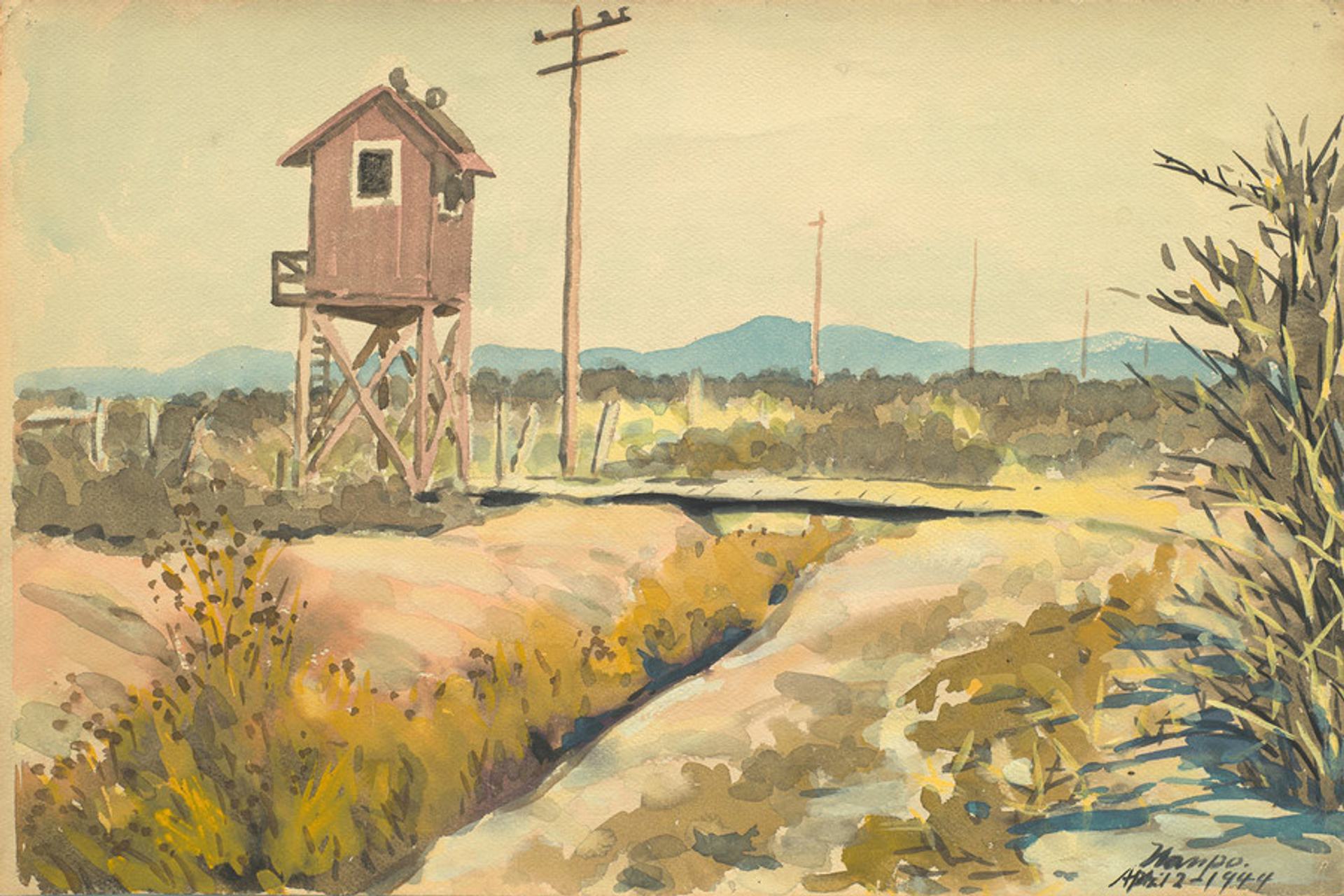
This exhibition was originally curated by Dr. Lydia Nakashima Degarrod for Monterey Museum of Art, Monterey, California, where it was exhibited from August 22 to December 15, 2024, and is now on view at the California College of the Arts (CCA) Campus Gallery.
Chikaji Kawakami's (a.k.a. Nanpo) watercolor landscapes, created while imprisoned at an internment camp in Topaz, Utah, stand as simultaneous acts of creativity and resilience. Kawakami joined Chiura Obata (and his associate George Hibi) who founded an art school within the prison camp, and collectively, they taught nearly a thousand internees between 1942 and 1945. Paired with landscapes by Chiura Obata, Kawakami's tranquil, dignified landscapes reflect Obata's influence, radiating calm and beauty despite his three-year imprisonment. Under the Guard Tower: The Watercolors of Chikaji Kawakami is curated by Oakland-based artist and scholar Lydia Nakashima Degarrod, and depicts life outside the barracks, documenting the harsh living conditions while giving his subjects the privacy, space, and dignity denied to them during incarceration.
About the Artists
Chikaji Kawakami
Born in 1882 in Kagoshima, Japan and immigrating to San Francisco, CA in 1904, Chikaji Kawakami (a.k.a. Nanpo) lived in Oakland, CA until 1942. Like Chiura Obata, he was imprisoned first at Tanforan and then at Topaz. As an Issei artist, Kawakami chose to depict beauty in the desolate landscape as a form of defiance and sanctuary, painting and teaching art to preserve both his Issei (first-generation Japanese immigrant) identity and the prisoners' dignity. History is often forged brave individuals, whom we discover only after they have left this world, and MMA is grateful for the Jim and Diane Coward Family Trust for allowing us to let our community come to know Chikaji Kawakami.
Chiura Obata
One of California's most important twentieth-century artists, Chiura Obata was born in 1885 in Okayama, Japan and emigrated to the United States in 1903. He was a professor at UC Berkeley when he and his family were taken first to Tanforan and then to Topaz. Even while incarcerated, he continued teaching, founding art schools that served nearly a thousand students. Obata believed that educating people in art would help them better endure the hardship of Topaz and create cooperation amongst people.
Support for this exhibition at Monterey Museum of Art provided by The Jim and Diane Coward Family Trust, Barbara Schilling and Richard Carr, and the Tanimura Family Foundation
Chikaji Kawakami (a.k.a. Nanpo) (1882-1949), Untitled, 1944, watercolor on paper, 12 x 18 in. Gift of the Jim and Diane Coward Family Trust, 2023.012.024.