News
Artist Feature: Christopher Lawrie on Apple and Art as Reflection & Transformation
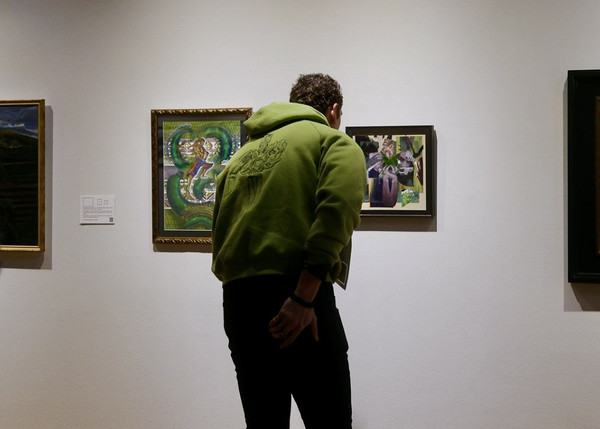
When I found out I'd been accepted into the Monterey Biennial, I was surrounded by longtime friends visiting Santa Cruz from San Francisco for a birthday. We were walking through the place I love most, laughing, reconnecting—and I get this email that I'm in the show. I could barely contain myself.
At first, the weight of it didn't hit me. Everyone around me was reacting—hugging me, gasping, genuinely excited. And I was just grateful. But it wasn't until I walked into the museum on opening day, standing in front of my piece surrounded by people I love, that it fully landed. That was a "pinch-me" moment.
My piece, Apple, began as something light—a conceptual remix album cover for a Charli XCX song. But my subconscious hijacked the process, and the work evolved into something much deeper.
At its core, Apple reframes the biblical story of Eve and the forbidden fruit, not as sin or betrayal, but as an act of self-liberation and longing. I wasn't interested in judgment or morality. I was thinking about what it means to reach for something, not because it's forbidden, but because it calls to you.
The composition began as a cross of faces and arms bearing the weight of emotions, shame, silence, and awakening. One hand covers a mouth, silencing the story only Eve can tell, the other forces an eye open, revealing truth, control, desire, and values we didn't choose but live inside anyway. Behind them, the Garden of Eden falls apart. Not in ruin, but in rebirth.
It became a visual metaphor for something I didn't realize I needed to express: my own healing. I had just come through a deeply traumatic chapter, and I threw myself back into my creative practices—painting, acting, writing—trying to rebuild from the inside. I didn't sit down to make art about trauma, but when I stepped back from Apple, I saw how much of my truth had poured into it. It held things I hadn't said out loud yet, and reminded me that I'd survived.
Standing in that museum, wearing a sweatshirt I'd had embroidered with my artwork, I felt whole. Not just seen, but aligned—like I was exactly where I was meant to be. I've always believed that art reflects the soul. This piece proved it.
If I could say anything to my younger self—the version of me still struggling to find value and voice—I'd remind myself that art was always my outlet, I had just forgotten my own creative voice, and gave someone else's priority. I'd say: "Don't lose your value. Don't give it all away. Stay true to your body, your mind, your vision. You're more powerful than you know."
And if someone were to look at Apple and ask, "What is this really about?" I'd lean in and whisper:
"When everything is coming to an end… when you're faced with the consequences of your own decisions… how prepared will you be to learn, grow, and begin again?"
Photograph by Jennifer Tomlin
About the Monterey Museum of Art
Now in its 65th year of operation, Monterey Museum of Art (MMA) cultivates curiosity in the visual arts and engages community with the diversity of California art - past, present, and future. Through exhibitions and programs, MMA reflects the creative legacies of the region and serves as a collaborative center where art and the community engage. Monterey Museum of Art inspires creativity, connects communities, and celebrates the stories of California art.
Monterey Museum of Art
559 Pacific Street
Monterey, CA 93940
Open Thursday - Sunday 11:00 am - 5:00 pm
www.montereyart.org
Media Contact
Alana Puryear
Director of Marketing and Communications
pr@montereyart.org
+1 (831) 372-5477 ext. 101